Showing posts with label treasury bonds. Show all posts

Wednesday, February 16, 2011

So Bad, They Are Actually Good

(Editor's Note: Paul Schatz, President of Heritage Capital, LLC, in Woodbridge, will be contributing to Fi$callyFit every Friday. Read his biography here)

I haven't written an article about the Treasury bond market in a while, probably because it's been in a very strong downtrend without overwhelming negative sentiment to help turn the tide. That's all changing now.

Since the summer, Treasury bond prices have imploded 14%, and yields have exploded higher by roughly 38%. (Remember, in the bond market, price and yields go in opposite directions) Those are historically enormous moves in such a short period of time, especially since the Fed is supposed to be buying up all those bonds in hopes of keeping interest rates low to help the still crippled housing market

Just like with stocks, commodities and real estate, it's amazing how many people are positive near peaks and negative near bottoms. Market sentiment is usually polarized. So if 100% is the absolute highest number of bulls and 0% is the lowest number of bulls, you can certainly become very interested at extremes above 90% and below 10%.

Would you personally rather buy when almost everyone is bullish or no one is bullish?

Long time readers already know that I am very contrarian in my thinking. Of our nine investment strategies, the majority seek to buy weakness and sell strength, more commonly known in the industry as mean reversion.

Usually, when we are buying into some type of decline, the number of investors with a positive outlook on the investment falls substantially, hence the selling and someone to sell to us. And when we attempt to sell into strength, there are hopefully a vast majority of investors positive, hence all the buying to drive the security up and someone to buy from us. If it was only so easy!

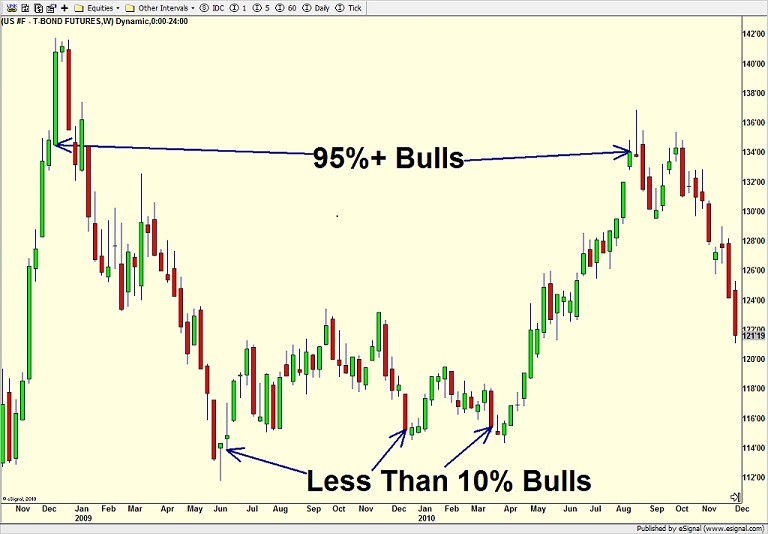
Below is a weekly chart of the 30 year treasury bond. You can see the two times over the past two years when the number of bulls was at least 95%. While it didn't exactly pinpoint THE high, it was fairly close and the turnaround wasn't too far off. It takes a substantial rally to turn that many investors bullish and get their money invested. So who is left to buy?

You can see in both cases, treasury bonds fell very hard soon thereafter. During the second half of 2009 and early 2010, bonds stayed in a wide trading range that was supported three times by less than 10% of investors positive. Finally, a spark ignited the rally to suck in all that money and register 95%+ bulls at the right.


The chart below has been dialed down to a daily time frame and you can see the preponderance of bulls on the far left and subsequent (and current) powerful downtrend that brings us to today. Just earlier this week, the number of investors (actually futures traders) sank to under 10%. This does not mean that bonds must immediately rally. As we saw above, it can be the beginning of a trading range. But history does show that the downside should be limited and the risk/reward now favors the upside.


As I said on CNBC's The Call this past week, treasury bonds are the most unloved investment right now and something that deserves consideration for at least a trade. Maybe this is a major bottom or it's still out there after a rally. It's too early to say. Wouldn't it be interesting if treasury bonds saw a significant low just as Bernanke & Co. ended their purchases?


Feel free to email me with any questions or comments at Paul@investfortomorrow.com.


Until next time…


Paul Schatz

Heritage Capital LLC
http://www.investfortomorrow.com/
http://RetirementPlanningConnecticut.com/
Follow us on Facebook at www.facebook.com/heritagecapital and on Twitter @Paul_Schatz

Friday, August 27, 2010

Stock Market at Critical Crossroad

(Editor's Note: Paul Schatz, President of Heritage Capital, LLC, in Woodbridge, will be contributing to Fi$callyFit every Friday. Read his biography here)


As I mentioned last week, I am interested in doing an article on real estate and would greatly appreciate your help in answering a few very short questions for 30 seconds if you haven’t already done so. Please click on the link below. There are no right or wrong answers! I’ll report back next week on the results along with my opinion.


In a recent issue of Street$marts, I reviewed my long-term forecast for a stock market peak this summer, but expected at least another significant push higher this month. So far, that call has been a big dud with the market deciding to pullback 5% instead. As we enter the final weeks of traditional summer, the major indices find themselves at an important crossroad.

IF (intentionally capitalized) the stock market has at least one more good rally left, which I still believe it does, it should begin in the next week and have some fireworks associated with it. Stocks are oversold based on a slew of technical measures and sentiment is extremely bearish, which is contrarian in nature suggesting a rally. While I doubt it will be a "rising tide lifting all ships", it should be strong enough to see some sectors make new 2010 highs. In short, as I discussed at length this morning on CNBC, it's time for the bulls to put up, take the ball and run or risk getting mauled by the bear next month.

As I've mentioned before, I continue to find it very interesting and almost curious that high quality corporate bonds, low quality junk bonds and treasury bonds are all making new highs for 2010. This is very atypical behavior for any market, let alone one that is trying to peak. Although I am glad our various programs own all three, it doesn't make me comfortable that the financial markets continue to behave in very unusual and unorthodox ways.

Way back in January, in my "11 Shockers for 2010" I forecasted and expected that longer-term treasury bonds to be the surprise investment of 2010, much to the disagreement of my peers and members of the media. But I really never expected their performance to be as strong as it’s been (up 20% based on TLT), something that's beginning to worry me now, given their parabolic advance. I thought they would return somewhere in the single digits (and they still may if they decline from here), while most other assets struggled along. Their near vertical ascent over the past month based on a dying economy with deflation has the smell of at least short-term trouble brewing sooner than later for treasuries.

Feel free to email me with any questions or comments at Paul@investfortomorrow.com.

Until next time…


Paul Schatz

Heritage Capital LLC
http://www.investfortomorrow.com/
http://RetirementPlanningConnecticut.com/

Friday, July 16, 2010

Better or Worse to Die in 2010?

(Editor's Note: Paul Schatz, President of Heritage Capital, LLC, in Woodbridge, will be contributing to Fi$callyFit every Friday. Read his biography here)

The stock market continued to rally over the past week and is up roughly 8% from the low on July 1 as I write this. As is usually the case coming off a significant bottom, the “easiest” money has been made with the initial snapback being the most vertical portion of any rally.

With Q2 earnings season coming in full bloom next week, it’s going to be very interesting to see market reaction more than what the actual earnings are. The reports should be fantastic, but the corporate guidance is more important. Stocks certainly could run further in the short-term, but a quick period of digestion is needed sooner than later to keep the nascent rally alive.

In my 11 Shockers for 2010, #7 was that treasury bonds end up as a top performing asset. So far, that asset class is up nicely on the year and continue to behave constructively. As hard to believe as it is, those boring bonds are up more than 10% since the beginning of April and still look appealing into any decent bout of weakness.

Now, on to the unusual estate tax issue…

So far, Congress has failed to reenact estate taxes for 2010, but that doesn’t necessarily mean no tax consequences for heirs in 2010.

Yes, estate taxes and generation-skipping transfer taxes were repealed at the end of 2009. Without Congressional action, they will be back in 2011 at rates from a decade ago of $1 million exempt from taxes and 55% taxes on the remainder. While Congress could pass estate taxes retroactive to January 1, 2010, the more time that passes from the start of the year, the messier that becomes to implement.

Barring new legislation, where taxes still come into play for a 2010 estate is cashing out an inheritance. Items sold from a 2010 estate will be taxable based on their original price. Inherit 1,000 shares of Amazon purchased in 1997 for $18 and sell them today for $130 per share, and you will have taxable gains of $112,000. At the 15% capital gains tax rate, $16,800 could be payable in capital gains taxes on the inheritance. As a result, individuals who might not pay estate taxes under even a $1 million exemption, may find themselves with a taxable inheritance.

The real problem for estates in 2010 will be wills designed to pass as much of the estate through tax free as possible. For example, a will might state that 100% of the estate that could be passed on tax-free be distributed to a designated charity while the remainder goes to the surviving spouse. Today, that could mean nothing for the surviving spouse.

I am scheduled to be on WTNH’s Good Morning Connecticut this Saturday, July 17th, at 7:35 am discussing what investors should do during the second half of 2010. You can view all of our past media appearances, good, bad and disastrous right here.

Feel free to email me with any questions or comments at Paul@investfortomorrow.com.

Until next time…

Paul Schatz
Heritage Capital LLC
http://www.investfortomorrow.com/
http://RetirementPlanningConnecticut.com/