Showing posts with label Bernanke. Show all posts

Friday, June 10, 2011

The 6 Week Nap


(Editor's Note: Paul Schatz, President of Heritage Capital, LLC, in Woodbridge, will be contributing to Fi$callyFit every Friday. Read his biography here)


Imagine you have been asleep for six weeks and just woke up.  The stock market has declined five straight weeks, a rare occurrence, and is working on six today. 

The sovereign debt crisis in Europe is percolating again with Greece, Ireland and Spain teetering.  Last Friday's employment report, as you can see below, showed very few jobs being created in May with unemployment ticking slightly higher again.  As I have mentioned before, if this was a normal recovery, job growth would be soaring right about now.  Since mid 2010, we are more like hovering.

Bernanke & Company's QEII, which pumped $600B into the system will be ending in a few short weeks.  And the S&P Case Shiller Index of home prices just hit an eight year low.  Yes, you read that right.  Home prices, except the ones we are trying to buy, continue to make post crisis new lows and are back to levels not seen since 2002 and 2003.


You would be hard-pressed to "feel good" right now.  One would have thought that stocks would be down 10-20% with this horrible backdrop.  But they are not.  From high to low, the stock market has pulled back 6%, yet another 4-8% pullback that I keep discussing.


If you add in the somewhat extreme nature of the selling wave along with the surge in investors buying protective put options and newsletter writers more bearish than bullish for five consecutive weeks, you have all the makings for at least a short-term low.  I am going to stick my neck out and say that the bottom is not in place yet and will likely need one more selling wave to hammer in. 


My theme for a while has been that there should be at least one more stock market rally left IF there is a big correction coming in Q3.  I still believe that.  All the makings are there.  Failure to rally in the coming weeks would usher in some not so pleasant memories of bear markets passed, which would mean sharply lower prices very soon.  But we can cross that bridge if and when it happens.
FYI, I will be on CNBC’s Squawk Box at 6:10am on June 13.
Feel free to email me with any questions or comments at Paul@investfortomorrow.com.
Until next time…
Paul Schatz
Heritage Capital LLC
Follow us on Facebook at www.facebook.com/heritagecapital and on Twitter @Paul_Schatz

Thursday, April 28, 2011

Stock Market Building Towards THE Peak

(Editor's Note: Paul Schatz, President of Heritage Capital, LLC, in Woodbridge, will be contributing to Fi$callyFit every Friday. Read his biography here)

As I write this Federal Reserve Chairman Ben Bernanke is just beginning his first ever, "official" press conference. As savvy as he is, (remember his first 60 Minutes interview right at the bear market low?) I doubt that we will hear anything unexpected in his remarks or his answers to media questions.

The latest bull run in stocks that began on March 16 remains alive and well. A few weeks ago, I offered that since we saw some of the key indices making new highs, that boded well for the others to play catch up. Since then, the Dow Industrials, Dow Transports and S&P 500 have scored fresh highs with the Nasdaq 100 a few cents away.


On the flip side, volume remains woefully pathetic and eventually that's going to matter. Sector leadership is very good, BUT the key financial sector is behaving very poorly. With the indices at new highs and this group in a downtrend, something has to give sooner than later.

So far, nothing has changed in my thinking that a possible significant peak is building sometime this quarter. Besides what I've already mentioned, I am focusing on the junk bond and small cap areas where the first sign of evaporating liquidity should be seen.

The initial decline from any major top is going to look exactly like every other small pullback, only in this case, the next rally will fail short of new highs and a sharp, relentless decline will ensue. As always, we will take it one step at a time and do our best to protect the gains we've been fortunate enough to make.

I hope that none of you are sitting back, complacently believing that we survived 2008 and all is good in the world. That we are on the cusp of another decade long bull market to untold riches. In case you haven't realized it, the stock market (and many, many, many mutual funds) is at the same level it was 12 years ago! That's essentially 0% return on your money BEFORE inflation! So factoring in that pesky inflation thingy, you end up with a significant loss.

I urge you! I beg you!! You have a plan in place in case you get into a car accident. You have a plan in place in case your house burns down. Don't sit back and hope that everything works out with your money. Now is not the time to procrastinate. It's the time to put a plan together. Investors don't plan to fail; they fail to plan!

Feel free to email me with any questions or comments at Paul@investfortomorrow.com.

Until next time…

Paul Schatz

Heritage Capital LLC
http://www.investfortomorrow.com/
http://RetirementPlanningConnecticut.com/

Follow us on Facebook at www.facebook.com/heritagecapital and on Twitter @Paul_Schatz

Wednesday, February 16, 2011

So Bad, They Are Actually Good

(Editor's Note: Paul Schatz, President of Heritage Capital, LLC, in Woodbridge, will be contributing to Fi$callyFit every Friday. Read his biography here)

I haven't written an article about the Treasury bond market in a while, probably because it's been in a very strong downtrend without overwhelming negative sentiment to help turn the tide. That's all changing now.

Since the summer, Treasury bond prices have imploded 14%, and yields have exploded higher by roughly 38%. (Remember, in the bond market, price and yields go in opposite directions) Those are historically enormous moves in such a short period of time, especially since the Fed is supposed to be buying up all those bonds in hopes of keeping interest rates low to help the still crippled housing market

Just like with stocks, commodities and real estate, it's amazing how many people are positive near peaks and negative near bottoms. Market sentiment is usually polarized. So if 100% is the absolute highest number of bulls and 0% is the lowest number of bulls, you can certainly become very interested at extremes above 90% and below 10%.

Would you personally rather buy when almost everyone is bullish or no one is bullish?

Long time readers already know that I am very contrarian in my thinking. Of our nine investment strategies, the majority seek to buy weakness and sell strength, more commonly known in the industry as mean reversion.

Usually, when we are buying into some type of decline, the number of investors with a positive outlook on the investment falls substantially, hence the selling and someone to sell to us. And when we attempt to sell into strength, there are hopefully a vast majority of investors positive, hence all the buying to drive the security up and someone to buy from us. If it was only so easy!

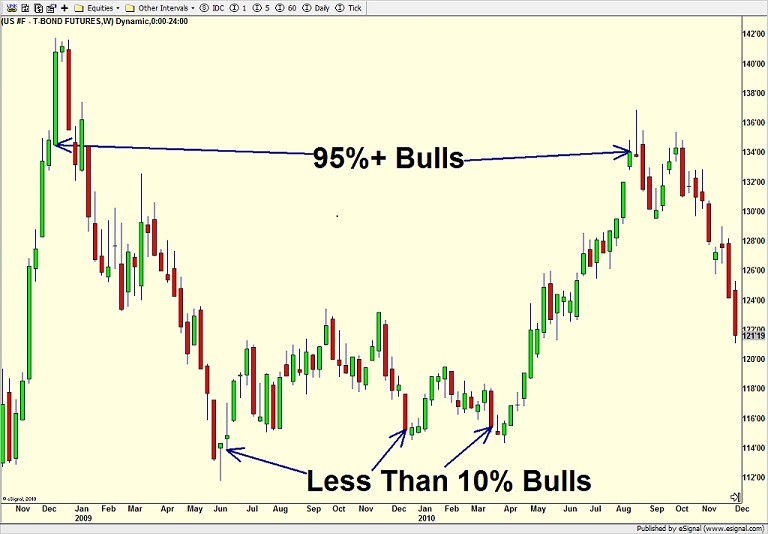
Below is a weekly chart of the 30 year treasury bond. You can see the two times over the past two years when the number of bulls was at least 95%. While it didn't exactly pinpoint THE high, it was fairly close and the turnaround wasn't too far off. It takes a substantial rally to turn that many investors bullish and get their money invested. So who is left to buy?

You can see in both cases, treasury bonds fell very hard soon thereafter. During the second half of 2009 and early 2010, bonds stayed in a wide trading range that was supported three times by less than 10% of investors positive. Finally, a spark ignited the rally to suck in all that money and register 95%+ bulls at the right.


The chart below has been dialed down to a daily time frame and you can see the preponderance of bulls on the far left and subsequent (and current) powerful downtrend that brings us to today. Just earlier this week, the number of investors (actually futures traders) sank to under 10%. This does not mean that bonds must immediately rally. As we saw above, it can be the beginning of a trading range. But history does show that the downside should be limited and the risk/reward now favors the upside.


As I said on CNBC's The Call this past week, treasury bonds are the most unloved investment right now and something that deserves consideration for at least a trade. Maybe this is a major bottom or it's still out there after a rally. It's too early to say. Wouldn't it be interesting if treasury bonds saw a significant low just as Bernanke & Co. ended their purchases?


Feel free to email me with any questions or comments at Paul@investfortomorrow.com.


Until next time…


Paul Schatz

Heritage Capital LLC
http://www.investfortomorrow.com/
http://RetirementPlanningConnecticut.com/
Follow us on Facebook at www.facebook.com/heritagecapital and on Twitter @Paul_Schatz

Thursday, February 10, 2011

Impending Debt Crisis Needs to be Addressed

(Editor's Note: Paul Schatz, President of Heritage Capital, LLC, in Woodbridge, will be contributing to Fi$callyFit every Friday. Read his biography here)

With my Fearless Forecast and Top 15 Shockers for 2011 already done, we will be heading back to some more “normal” topics. Those two pieces are two of the more enjoyable contributions I do each year, although they are more for fun than education.

This past week, Yahoo! invited me to the NASDAQ Market Site in Times Square to record an interview based on my shockers list. We ended up speaking for almost 30 minutes and they divided the interview into three segments that were posted on Yahoo! Finance. If you want to watch them, here they are:


Look Out Emerging Markets Investors!

2011 Political Shockers

NOT Your Normal Economic Recovery


One of the country’s themes in 2011 is the impending debt crisis. It’s one of the few things both democrats and republicans can publicly agree on! It used to be a question of “if”, but sadly, it’s now a question of “when”. America has been a global political, economic and military power for about 100 years. If this issue is not dealt with seriousness and a sense of urgency, the U.S. will end up being like previous world powers, wounded and no longer able to dominate.

I have heard comparisons to the Roman Empire, but frankly, I am not smart enough for that analysis. The one that does resonate with me is England or Great Britain or the United Kingdom, whichever way you want to discuss that region. During the 1900s, she enjoyed some of the same power status that America has today. But once she fell from grace, her economy never was able to get back to a leadership role. Sure, that economy can grow, but like some other European countries, it’s been sub par growth from being weighed down by fiscal issues.

Anyway, I am sure there are millions of academics that can explain this better me, but I think you get the gist. I came across an interesting example of how much cutting $100 million from the federal budget actually means. The video pokes fun at President Obama, which in this case, is not my intent. It could have easily targeted almost anyone in government the past 10 years and certainly former President George Bush.


Budget Cuts

It does underscore how serious and almost dire our situation is at the current pace. $100mm is almost nothing. Sad but true. The U.S. has reached the point of only painful outcomes. Trying to grow our way out of the fiscal crisis won't cut it anymore.

And as Bernanke has said many, many times, we have to be very careful not to cut too hard initially and bury the nascent recovery. In reality, the government must agree on a plan to cut a MINIMUM of $100 billion a year for the next 10 years, with increasing amounts as the years go on.

And before you assume I am going to slam Obama for this, think again. While his deficit reduction plans have been seriously underwhelming, all I hear is rhetoric from the other side. Although I am a fan of Congressmen Eric Cantor and Paul Ryan, I have yet to hear any substantive and specific cuts their side would endorse.

I think both parties should cease with the nonsense and garbage and offer the American people details. It's laughably pathetic that the vast majority of politicians want to protect social security, Medicare and defense. It's not going to happen! Throw in the amount we pay to service the national debt and there's really not much left to cut.

If you recall the movie A Few Good Men, at the end, when Tom Cruise is questioning Jack Nicholson on the stand. Cruise yells, "I want the truth!", to which Jack replies, "You can't handle the truth". That's where I think we are with Washington. Americans deserve the truth. We have earned it!

Feel free to email me with any questions or comments at Paul@investfortomorrow.com.


Until next time…

Paul Schatz
Heritage Capital LLC
http://www.investfortomorrow.com/
http://RetirementPlanningConnecticut.com/

Follow us on Facebook at www.facebook.com/heritagecapital and on Twitter at Paul_Schatz

Friday, February 4, 2011

Top 15 Shockers For 2011

(Editor's Note: Paul Schatz, President of Heritage Capital, LLC, in Woodbridge, will be contributing to Fi$callyFit every Friday. Read his biography here)

Each year, I usually release a small list of somewhat off the wall things that I think have some chance of occurring. Some shockers are repeats. Obviously, I hope that all of the less than positive ones don't happen. This is not my forecast for 2011, which I hope has a better chance of coming true!

Before I get to this year’s list, let’s do a quick review of what I offered last year. You’ll see my comments on how each did in italics.

Last Year’s 2010 Shockers:

1 - At least one major European country defaults on its debt
With so many crises that the ECB had to fight, I’ll put this in the correct column.

2 - The Euro sees a country leave, causing further strains in the union
Very close with Greece!

3 - A municipal bond crisis unfolds in the US
No crisis, but that sector was certainly pounded during the final four months of the year.

4 - Heading into its third decade of deflation and economic ruin, the graying and flat population of Japan begins to open its borders to immigration and remilitarizes, hoping to shock and stimulate their economy
Not yet.

5 - Aided by a resurgent economy, the Democrats retain both houses and Congress and super majority in the Senate
Not even close!

6 - Tim Geithner resigns from the Treasury citing personal reasons to spend more time with his family and embark on a career in the private sector, payback to him for having helped Wall Street "swindle" hundreds of billions from taxpayers
Too bad it didn’t happen.

7 - Treasury bonds end the year as one of the top performing assets
They were sailing ahead up more than 25% during the summer before giving back more than half the gains.

8 - Citibank is broken up and sold off in pieces and loses its name
Not until Uncle Sam goes totally away.

9 - Goldman Sachs goes private since the benefit of being public, added capital and huge leverage is no longer there
Nope.

10 - Citizens of Iran rise up against their government and begin a revolution. Iran responds by attacking Israel in an ill-conceived attempt at rallying public support behind a collapsing government.
Thankfully no.

11 - The stock market peaks during the third quarter and a new bear market begins.
The stock market saw a significant peak in April, followed by a 15%+ correction, but it was just in the context of an ongoing bull market.

12 – The Jets win the Super Bowl. Hey, I can dream! (actually, it’s San Diego)
Will my Jets ever get back to the party?


So now, let’s roll out the Shockers for 2011!

1 – After toiling in obscurity for more than two years while its energy cousins doubled and tripled, natural gas finally has its day in the sun as one the surprise investments of 2011, almost doubling!

2 – The Euro currency’s quiet bear market reinvigorates itself and heads to new five year lows and towards the ultimate shocker of parity (100).

3 – Under tremendous pressure from both within and the financial markets, Bernanke & Co. do not launch QE3 when it ends in June. Initially cheered by all, this leads to major asset peaks in stocks, commodities and high yield bonds.

4 – Joe Biden suddenly resigns the vice presidency and is replaced by Hillary Clinton, virtually assuring Barack Obama of reelection in 2012.

5 – Riding a renewed wave of cooperation with John Boehner and Congress, Barack Obama’s popularity soars to heights forcing quality republican candidates to withdraw.

6 – Powerhouse countries China and India lead the emerging sector to strongly choke off inflation by raising interest rates and draining liquidity. In turn, the bull market in emerging markets comes to a grinding halt.

7 – Generation bubbles in cotton, sugar and coffee burst, sending these highflying commodities in a tailspin.

8 – Driven by the wildest global weather on record, wheat, corn and soybeans soar to record highs, eclipsing the bubble prices of 2008.

9 – Contrary to widespread, depression like prognostications from Meredith Whitney, the municipal bond market does not collapse in crisis.

10 – The public’s love affair with investment grade and high yield corporate bonds ends.

11 – After two years and almost 100% rally, the public finally plows back into stocks, just like they did with tech in 1999, housing in 2006 and energy in 2008, precisely at the wrong time, leading to yet another case of getting caught holding the bag.

12 – While the economy chugs along during the first half of the year and the unemployment rate slowly declines, the trend sharply reverses during the second half as GDP slows and the ranks of the unemployed rises.

13 – The security no one wants to own, long-term U.S. treasury bonds, sees a dramatic resurgence during the second half of 2011.

14 – Investors infatuation with Apple and Netflix turns to sobs, tears and saturation as the outperformance grinds to a halt and turns rotten to the core as it’s streamed through our living room.

15 – The once storied New York Mets are the doormat of the National League East, unable to win even 70 games as the Red Sox and Phillies dominate Major League baseball.

A little longer than planned, but I hope you enjoy it anyway!


FYI, I will be on CNBC's The Call on February 8 at 9:35am.

Feel free to email me with any questions or comments at Paul@investfortomorrow.com.


Until next time…

Paul Schatz
Heritage Capital LLC
http://www.investfortomorrow.com/
http://RetirementPlanningConnecticut.com/

Follow us on Facebook at www.facebook.com/heritagecapital and on Twitter at Paul_Schatz

Thursday, January 13, 2011

Q4 in Review

(Editor's Note: Paul Schatz, President of Heritage Capital, LLC, in Woodbridge, will be contributing to Fi$callyFit every Friday. Read his biography here)

As I reviewed Q4 of 2010, I was shocked to find how many folks had a sudden case of selective amnesia. It’s an affliction that affects people in the investment, usually two years after a bear market.

I think we all know and remember how tough 2008 was. Emotionally, financially, economically, systemically, politically. The very core of capitalism was being threatened, not to mention the very real risk of a modern day depression. Money managers all over the world saw their worst weeks, months, quarters and years of their entire career. The "deer in the headlights" syndrome fell over a good part of the industry.

What I find so "interesting", just three years later, is how many people either predicted the whole financial crisis and bear market or actually had an up year for clients. I cannot remember the last person who told me they got crushed in 2008. All I hear now is "well I knew it was coming" or "we finished in the black". You knew what was coming? You finished in the black what? Hole?

It's really incredible. I don't know if it's revisionist history or selective amnesia, but it sure sounds like a lot of bull to me! While our business really grew in 2008, and none of our programs lost what the market did, I don't think I want to live through a repeat of that scenario any time soon. There was nothing fun about it.

Turning to the highlights of Q4… Lacking during the final three months of 2010 was the theme of non U.S. geopolitical news. On that front, it was nice and quiet! North Korea may have rattled their saber, but that seemed more like a child craving attention than a nation on the verge of war.

The major headline news was two-fold and occurred during the same week in November. First we had the all important mid-term Congressional and Gubernatorial elections where the Republicans achieved an historic victory, more than reversing the tide from 2008. As I've written about before, I believe this will have positive implications for the markets and economy in 2011 by preventing the largest tax increase in history as well as temporarily cutting the payroll tax by two percentage points.

Not to be overshadowed, Bernanke & Co. formally announced the worst kept secret on Wall Street, another round of quantitative easing or QE2 to the tune of another $600B through June 2011. By QE2, the Fed has been buying the Treasury Bonds sold by the Treasury in hopes of keeping interest rates down.

Interestingly, the unintended benefit of QE2 has been the very positive correlation between the Fed's buying and the stock market rising. Almost every single day in December was up for stocks without even a single down day of 0.50%. That is historically remarkable! Given how poorly QE1 ($1.2T) supported the markets, it's astonishing on the surface that QE2 has been a risk investors' home run.

On closer examination, QE1 was attempted while the markets were in a clear downtrend, actually free fall. The government was trying to catch a falling knife. Bernanke & Co. must have learned their lesson as QE2 was initiated during a solid uptrend with much better results so far. Additionally, just like with interest rate cuts, it does take time to have all that money filter through the system. While Q4 was void of bad news, and I certainly hope that continues, the odds don’t favor another long stretch without some shoe falling somewhere.

FYI, I will be on CNBC's Worldwide Exchange on January 20 at 5:35am.

Feel free to email me with any questions or comments at Paul@investfortomorrow.com.


Until next time…

Paul Schatz

Heritage Capital LLC
http://www.investfortomorrow.com/
http://RetirementPlanningConnecticut.com/

Friday, January 7, 2011

Fearless Forecast 2011

(Editor's Note: Paul Schatz, President of Heritage Capital, LLC, in Woodbridge, will be contributing to Fi$callyFit every Friday. Read his biography here)

One of the most worthless yet enjoyable topics of the year is the pundits annual forecast.

An unusual amount of time is spent discussing this in the media, but after January, no one ever reviews again nor seems to care. I usually end December with an idea of what I see ahead and then adjust according to how many others agree with me. As you know from reading the blog, I don’t like to be in the majority as that group is typically wrong.

Before I get to my forecast, which is not my annual “Shockers” list due out later this month, let’s do a quick review of what I envisioned for 2010.

Stock market - I thought we would see a generally flat market, somewhere between -5% and +5%, not the 15% we so gladly enjoyed! I thought the April peak would stand for the year. Stocks did go higher at the end of the year, but that call was pretty much correct. I forecasted a double digit decline, but thought it would unfold in Q4. We saw a 16% hit during the summer.

Long-term treasuries - would be a surprise leading asset class. They actually melted up through August and then melted down through November, finishing up 9%.

Dollar - I was bullish the dollar in 2010 and it gained a whopping 1.37%.

Gold - I was positive on gold and it gained 29%.

Inflation – It’s been the same forecast for 2010, 2009, and 2008. Inflation remains under wraps and not problematic.

Economy – I thought GDP (gross domestic product) would hang in above 0% during the first half and slip back into negative territory later in the year. I was right on the first part, but wrong on the second part.

Bernanke & Co. – Short-term rates would not be touched in 2010 and they are still in the same spot as they were 12 months ago.

So now, let’s get to my forecast for 2011

 The sooner I get it out there, the sooner I can be proven wrong! As always, I had a lot of fun thinking about it and creating it, although it has no bearing on how we manage money for our clients.

Stock market – We are now in the 3rd year of Obama’s term (presidential cycle) and traditionally, it’s the most bullish of all with an average return of 17% and only one down year in the past 70 years. When you examine the stock market decade by decade (decennial pattern), you find that the first few years of the decade tend perform worse than later in the decade. That’s two nice contradicting pieces.

Let’s add the almost uniformly bullish predictions from Wall Street into the mix with the average strategist forecasting double digit returns. Even former Merrill Lynch honcho and usually skeptical Richard Bernstein sees a 15-20% return for stocks. That’s shocking and worrisome! I have research dating back to 1990 and that group has been wrong roughly 75% of the time, although they hit the bulls eye in 2010. Kudos!

For 2011, I think the stock market will end the year modestly in the black, but only in the mid single digits. I envision corrective behavior in the spring with a more significant correction in late summer to fall.

Long-term treasuries – After attempting to rally in Q1, bonds resume their slide during the first quarter and into Q2, but firm up during the second half of 2011.

Dollar – I remain bullish on the greenback over the long-term, even if we see another selling wave back to the old lows. Ultimately, I think the dollar index will hit 100 and the euro will slide back below 100.

Gold – Clearly, after back-to-back strong years, gold is due for some pause to digest, in the short, intermediate and long-term. That can take shape in many ways. I think 2011 will bring a significant increase in volatility and I would not be surprised to see a $100 down day during the year. When all is said and done, I believe we will see at least $1500 hit during the first half of the year, but not another vertical assault like we saw in 2009 and 2010. Based on history, the year should end up with modest single digit returns, best case scenario, but outperforming its cousin, silver. Should that roadmap unfold anywhere close, that could set the stage for a monster blow off to the upside in 2012. But that’s getting laughably ahead of myself.

Inflation – Unlike the past few years, I see headline inflation percolating a bit, especially during the first half of the year, but the core (excluding food and energy) remaining tame.

Economy – If this was a “normal” recovery, GDP should explode higher this year, but especially during the second and third quarters. But I just can’t subscribe to the “normal” recovery theme. The economy has been juiced with free and easy money for years and once that spigot is turned off, similar to what FDR did in 1937, I believe we are in for trouble. Thankfully, Congress learned from their predecessors’ mistakes in 1937 and did not allow taxes to increase in 2011. Don’t underestimate how much that saved the economy and markets!

Federal Reserve – As the voting members of the FOMC turnover, expect the Fed to mirror Washington and get stuck in gridlock. Bernanke loses some internal power with Kevin Warsh sliding more towards the hawkish side and Plosser and Fischer coming back to dissent and push a more neutral stance once QE2 runs out by June. Keep a close eye on the two year note as the markets may force Bernanke’s hand later in 2011 to take action he clearly won’t want to take.

Unemployment – Sadly, the jobless recovery continues and unemployment stays stubbornly elevated above 8.75%. I think it’s going to take a second recession to cleanse the system and get put unemployment on a path back to 6% or lower sometime later this decade.

Natural Gas – Surprise! Surprise! Finally, the bulls take control and natural gas ends up as one of the top performing assets of the 2011.

So that’s it. Another fearless forecast in the books. I may add some items next Friday as I continue to read, research and digest, but I think you get the picture. As always, I am eager to hear to your comments. Please don’t be shy about emailing me!

FYI, I will be on CNBC's Squawk on the Street on Jan. 11 at 9:35 a.m.

Feel free to email me with any questions or comments at Paul@investfortomorrow.com.


Until next time…


Paul Schatz
Heritage Capital LLC
http://www.investfortomorrow.com/
http://RetirementPlanningConnecticut.com/

Friday, November 12, 2010

If It's Obvious... It's Obviously Wrong

(Editor's Note: Paul Schatz, President of Heritage Capital, LLC, in Woodbridge, will be contributing to Fi$callyFit every Friday. Read his biography here)

In my Special Election Update, I discussed the three big events for the markets last week, the election, Fed announcement and jobs report. The market's reaction to the election could not have been more expected. As I mentioned, a Republican takeover of the House with at least 60 seats and headway in the Senate was fully baked in the cake. That's why stocks did almost nothing the next day.

Bernanke & Company also gave the markets exactly what they were looking for with another round of quantitative easing to the tune of $600B (whether that’s good medicine is a topic for a different piece). Say what you want about this Fed, but they have done an excellent job of telegraphing their moves well in advance and making sure not to disappoint the markets. In typical Fed day fashion, stocks were quiet in the morning and saw a brief surge in volatility before modestly rallying into the close.

The surprise of the week came on "no news" Thursday when most of the major markets surged higher with the Dow, S&P 500, S&P Mid Cap, Nasdaq and Dow Transports all scoring breakouts to new 2010 highs. Only the lonely Russell 2000 index of small caps remains below its April high.


Since mid October, I've been concerned that the rally from where we committed so much money at the July bottom was getting a bit ahead of itself.  Not so much where we would pull the ripcord, but enough that should warrant a short-term pullback to digest those gains.  With so many bears becoming bulls, a surge in call buying by option traders and sentiment surveys showing a bit too much excitement, taking some chips off the table seemed like a good plan.


So far, the market hasn't cared. After last week's price action and heavy news flow, it's pretty hard to find many folks negative on the stock market with most of the major indices at new 2010 highs and the Fed committed to pumping another $600B into the markets. If their first round of QE with $1.25T was any indication, the old adage of "don't fight the Fed" should be wise to follow.

But the skeptic in me still worries. It's getting too easy. No one is worried anymore. Just buy stocks, commodities and high yield bonds. Sell the dollar and treasuries. It's a layup! History (and Joe Granville) has taught me when it's obvious... it's obviously wrong.

That's why I started pounding the table to buy the dollar last week. There are NO bulls left. Everyone is bullish on the Euro and bearish the greenback. That's the exact opposite of what we saw in late May when I offered on CNBC that the Euro was so bad, it was actually good. You had to just hold your nose, close your eyes and buy it.

Everyone seems to be embracing this new world financial order. Quantitative easing is supposed to help the economy by flooding the system with more and more money, which in turn lowers interest rates and helps banks, corporations and consumers.

I don't know about you, but besides helping fuel the financial markets, I don't see the positive economic effects that QE is intended. Money in the system isn't the problem. Banks have more than a trillion dollars sitting at the Fed earning peanuts, while corporations are also sitting on more than a trillion in cash, unwilling to spend and invest.

Summing it all up, although the major stock indices, sectors and high yield bonds have all broken out to new 2010 highs and everyone is partying like it's 1999, I am not willing to imbibe any more beverages. We have plenty on the table, but less than the maximum we had during July, August, September and half of October.

The most bullish thing stocks could do right now would be a sideways digestion for at least a week to wind up for another move higher. I think it would be constructive to see an orderly pullback of 2-4%. Much more than that would indicate that the recent breakout was false and sharply lower prices could ensue. As I mentioned last week, I would be very surprised to see stock breakout and explode higher without a pause. I think that would be dangerous and perhaps even a terminal move.

Feel free to email me with any questions or comments at Paul@investfortomorrow.com.


Until next time…

Paul Schatz

Heritage Capital LLC
http://www.investfortomorrow.com/
http://RetirementPlanningConnecticut.com/

Friday, June 4, 2010

Is Inflation STILL Dead?

(Editor's Note: Paul Schatz, President of Heritage Capital, LLC, in Woodbridge, will be contributing to Fi$callyFit every Friday. Read his biography here)


Last week, I talked about the Summer Rally Trying to Begin. The stock market was showing classic signs of being washed out of sellers with so many indicators reaching extreme levels, like pulling the rubber band and finally letting go to snap back in the opposite direction. Everything was set up for a rally to begin, unless of course, it was one of those once every 10 or 20 years where the system temporarily breaks and we see an elevator shaft mini crash. The odds heavily favored the rally.

Fast forward a week and the market is basically in the same spot. We saw two modest down days and one big up day, plus today (June 3) which is up slightly as I write this. Stocks are “supposed” to get in gear to the upside now, but they are certainly taking their sweet time. The longer it takes to really get going from an extreme oversold condition, the less powerful the rally usually is.

Since I stand by my year old forecast that the next rally is the last one before a major correction sets up, the market continues to live on borrowed time. As a bull, I would like to see the Dow Jones close above 10,500 to confirm the bottom has been hammered in and set the stage for a move towards 11,000. I reiterate my risk/reward comment from last week that it’s plus or minus 5% on the downside and 10-15% on the upside.

Although I’ve been very positive on gold since Gold Getting Ready for Another Assault in mid March, my position has not changed one bit in the past THREE YEARS that inflation is dead, kaput, dormant, asleep, etc. As I’ve mentioned before I am far from a gold bug, even though our firm has more assets in our two gold strategies than the other seven and rising gold has significant benefits here.

Research has shown that gold is not a good predictor of inflation nor is it the best protector against inflation. In industry jargon, you could say that gold is not highly correlated to the CPI, which is the consumer price index, a popular measure of inflation.

For a long while, I’ve struggled to figure out how I could be positive on gold, yet still believe that deflationary forces are the dominant player in our economy. Deflation, the general decline in the price of goods and services, is the exact opposite of inflation and was the topic here last year, DEFLATION: The REAL Boogeyman to Fear. During “normal” deflationary times (if you can even use such a cavalier word for this), which there are only two modern day examples, almost all assets decline in value. It’s often referred to a black hole or spiral as the gravitational pull sucks everything in and won’t let it out.

Anyway, during deflation, as we saw in the 1930s and Japan since 1990, gold declines along with other hard assets. As we saw in 2008, there is mass run to the safest currency, the U.S. dollar, along with other “safe” instruments like treasury bills, notes and bonds.

So, if I think deflation has more to play out, how can this foot with being positive gold?

My answer comes from looking across “the pond”. The Atlantic Ocean, that is. The only way I can see gold rallying during another bout of deflation is if we see a stampede away from paper currencies. We’re all watching the mini collapse of the Euro currency now as their problems continue to worsen. What if those problems spread to Asia and back to America later this year and into 2011 and 2012? Wouldn’t that cause the global governments to fire up the printing presses that would make 2008 look like a picnic? That’s the only way I can see gold rallying with deflation. It’s not a pretty picture and I pray the various Feds and governments wake up fast enough to head off that stampede.

Back to inflation (or the lack thereof) to finish this post. I never bought the idea when the Fed began printing money and creating all these cutting edge, outside the box programs that inflation would rear its ugly head. And when they went to Red Alert, their quantitative easing programs and began buying treasury bonds and mortgage backed securities, I knew Bernanke was in panic mode that a deflationary spiral was setting in.

I’ve said this for three years now. Ben Bernanke would light up a cigar, open the best bottle of wine he could find and do a victory dance if the Fed could somehow engineer a little inflation. With wage growth negative, capacity utilization modestly recovering from the abyss and money velocity tame, there is almost zero chance for problematic inflation until we overcome the deflationary pressures.

FYI: I will be on CNBC’s The Call on Mon., June 7 between 11:05am and 11:20am.

Feel free to email me with any questions or comments at Paul@investfortomorrow.com.

Until next time…


Paul Schatz


Heritage Capital LLC


http://www.investfortomorrow.com/

Friday, March 12, 2010

Stock Market Getting Tired But Higher Prices Still Lie Ahead

(Editor's Note: Paul Schatz, President of Heritage Capital, LLC, in Woodbridge, will be contributing to Fi$callyFit every Friday. Read his biography here)

In early February I contributed a piece here entitled, Bottoming Process Continues, where I made the case that stocks had either just bottomed or were about to, and that would lead to another strong run to new 2010 highs. I wrote similar articles in my newsletter, Hang in Bulls... Bears Almost Done that was followed up with Bottoming Process Continues Building. After forecasting a 4-7% pullback in January (we saw 8.5%), I was very confident that the decline was close to ending and a new leg higher would ensue, carrying the major averages above their 2010 highs on the way to Dow 11,500 - 13,000 when the weather turned warm.

Although rare, it's always nice when the market perfectly cooperates with your thought process and even nicer when your clients are the beneficiaries! So here we are, back at the highs and everything looks mighty rosy again, right? Well... kinda, sorta.

My forecast for the Dow remains in play sometime between Memorial Day and Labor Day, but the very short-term is a bit cloudy with the worst volume pattern since the bull run began. Volume is so important as it is the horsepower of the market’s engine. The stock market can fall and fall on light volume, but sustainable rallies have always required increasing volume. Stocks have rallied in almost straight line fashion, but are in need of a quick pause to refresh. My favorite analogy is that of the great steakhouse dinner.

Between the appetizer, salad, steak, various sides, wine and dessert, you can barely stand at the end of the meal. And before it's time for your next feast, you must digest the food. Markets work in similar ways. After a big rally, the market has to digest to make room for the next meal. The bigger the rally, the longer the digestion. In the current case, all the market needs is a good, short-term cleansing before it's ready to eat again.

I imagine that whatever weakness we are going to see should be right ahead of us. How long it lasts and how deep it goes are questions that will be answered along the way. In the most bullish case, we'll see a few nasty down days that look and feel really bad, but end quickly. But if investors don't increase their level of worry and don't become more concerned after a few days like that, we'll probably see a deeper and longer pullback. The first level I am watching is 1120 - 1125 on the S&P 500 and 10,300 - 10,400 on the Dow.

Should this pullback materialize, and it rebuilds a little worry in the market, I think it can be bought with both hands for another move to new 2010 highs during the second quarter. As I've mentioned before, one of the most important things to watch is sector and index leadership. Before any "real" correction (10-20%) sets up, there should be some clues here from what's leading and lagging.

Over the past year, with all the cheap and easy government money being thrown around, the financial markets have done nothing seriously wrong to jeopardize the bull run. But with Bernanke & Co. already beginning to pull the punch bowl by ending their trillion dollar purchase of mortgage backed securities and the Obama administration raising taxes in 2011 by letting the Bush tax cuts expire, the markets are much closer to another problem later this year and into 2011.

Please feel free to email me with any questions or comments at Paul@investfortomorrow.com.

Until next time…

Paul Schatz

Heritage Capital LLC
http://www.InvestForTomorrow.com